
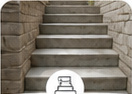
Safer outdoor steps feel predictable. Consistent risers and treads, adequate landings, controlled water, suitable texture, visible edges, lighting and properly planned handrails work together. Coatings cannot correct poor geometry, settlement or structural movement.
Consistent dimensions, sound landings, visible edges, suitable texture and controlled water are the foundation of safer outdoor steps.
Make every step predictable
Riser and tread differences interrupt a person's rhythm
People learn the height and depth of a stair from the first few movements. A noticeably different riser, a narrow tread or a sloped landing forces an unexpected adjustment. Measure the entire flight, including transitions at the top and bottom, rather than focusing only on the most damaged step.
New work should be laid out from confirmed finished elevations. Exact allowable dimensions and variation depend on the current code adopted for the property. Use the authority having jurisdiction rather than an old online diagram.
Create a stable pause
Landings must coordinate with door swing and walking routes
A landing gives a person space to open a door, turn or prepare for the stair. It should not force someone to stand on a tread while handling a door. Threshold height, porch construction and the route from the bottom step to the walk all affect the layout.
If an existing stoop has moved away from the home, adding material to the top may create new conflicts. The support, separation and entire entry geometry should be reviewed before a repair is chosen.
Treat water as a safety condition
Ponding, roof runoff and shade change how a stair performs
Treads and landings should shed water without sending it across the walking line or toward the door. Downspouts, roof valleys and adjacent slopes can concentrate flow. A textured finish cannot compensate for ice, algae or continuous water.
Use cleaning methods suited to the concrete and keep leaves and soil from covering edges. If a coating is considered, verify compatibility, traction and maintenance. It cannot fix settlement, inconsistent dimensions or unstable support.
Help people read the stair
Edge contrast and even lighting reveal changes in elevation
Uniform lighting should make every tread and landing visible without deep shadows or glare. Coordinate fixtures, conduit and switches before replacement when possible. Landscape lights should not be positioned where plants will quickly block them.
Visual contrast at a leading edge can help some users, but applied strips or coatings need durable attachment and appropriate traction. The treatment should remain consistent rather than marking only one unexpected step.
Plan support early
Handrails and guards require current code verification
The number of risers, open sides, height and relationship to a building influence handrail and guard requirements. The IRC contains model provisions, while the local jurisdiction determines what is adopted and enforced. A project quote should not rely on a generic statement that no rail is needed.
Attachment details matter. Posts or anchors should be coordinated with slab edges, reinforcement and waterproofing conditions before concrete is placed. An improvised rail added later may conflict with the usable width or edge strength.
Choose the durable scope
Movement and poor geometry often favor replacement
A small stable chip may be repairable. A flight with inconsistent dimensions, settlement, separation from the porch or widespread deterioration presents a different problem. A patch changes the surface but does not rebuild the entry geometry.
Replacement allows the supporting condition, landing, risers, treads and connection to the walk to be planned together. Access to the door will be limited during demolition and curing, so the household needs a temporary route and written use instructions.
| Observation | Likely question | Next step |
|---|---|---|
| Small edge chip | Is the remaining concrete sound? | Evaluate a localized repair |
| Uneven risers | Can geometry be corrected without rebuilding? | Consider replacement design |
| Settled stoop | What moved and is support stable? | Diagnose before repair |
| Water across treads | Where does runoff originate? | Correct drainage with the stair plan |
Use a careful visual check
Inspect the whole entry in daylight and after dark
Stand at the top and bottom and look for inconsistent heights, narrow treads, sloped landings, loose rail components, cracks and water stains. Walk the route slowly while carrying something similar to groceries. Then repeat after dark to see whether lighting creates hidden edges or glare.
Do not rely on a tape measure alone when a stair is moving or connected to a structure. Significant settlement, separation, loose guards or rapid change deserves qualified review before a cosmetic repair is attempted.
- Compare every riser and tread
- Test door operation and landing space
- Observe water after rain
- Check rail stability without overloading it
- Review lighting from both directions
Design for the people using it
Children, older adults and frequent carrying expose different problems
A step used only occasionally may hide issues that become obvious on a daily entrance. Small children, older family members and people carrying packages benefit from predictable geometry, clear landings and a reliable handhold when required.
Ask whether the entrance should accommodate future mobility changes. A different route, landing or ramp may require design beyond a simple step replacement, and those goals are easier to consider before demolition.